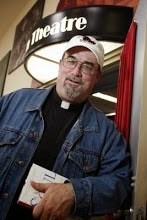
Rick Malloy, S.J., is a Jesuit priest and cultural anthropologist. He is the author of _A Faith That Frees: Catholic Matters for the 21st Century (2007) and _Being on Fire: The Top Ten Essentials of Catholicism_ (2014), both published by ORBIS Books
Monday, December 12, 2022
OUR LADY OF GUADALUPE
Advent III
On Monday Dec 12th we celebrate the feast of Our Lady of Guadalupe with Mass.Under the guidance of Ms. Rosalies Toledo, students reenact the events
of 1531 when Our Lady appeared, as brown skinned maiden, to a humble Juan
Diego.The image of Guadalupe on Juan’s
tilma can is still on display in Mexico city.
Sr. Mary McGlone, SSJ, writes of this feast:
“
"La Morenita," as Guadalupe is called affectionately, is the
patron of the Americas and undoubtedly our hemisphere's most beloved
manifestation of Mary, the mother of God. The designation, morenita,
refers to the fact that the image of Guadalupe depicts Mary as a mestiza, a
person of both European and American ancestry, a divinely fashioned mixture of
cultures.
Our Lady of Guadalupe
appeared just over a decade after the Spanish conquest of Mexico. In a time
marked by turmoil, abuse and prophecy, she epitomized the potential of the
Gospel to bring ancient traditions together to create something that neither
could imagine until they allowed grace to lead them into it. She embodied an
American expression of John the Baptist's voice crying in the wilderness.
Our Lady of Guadalupe shows that God cares for the poor and oppressed,
wants all injustice and oppression to cease, and loves us as a mother loves her
children.
This Advent,
as we prepare for Christ to be born again in our hearts, our minds, our lives
and our world, let’s meditate on the mystery and meaning of Our Lady of
Guadalupe.We are all called by God to
incarnate the Gospel values of hospitality, openness to others, and a mighty
striving for justice for all.
This month marks the 60th anniversary of the papal encyclical "Humani Generis," that laid out the Catholic Church's official relationship with Darwinian evolution. The pastoral letter, issued on Aug. 12, 1950 by Pope Pius XII, confirmed, in broad terms, that there is no intrinsic conflict between Christianity and the scientific theory of evolution. Considering that this was three years before the nature of DNA was even discovered, the pope's foresight in deciding to address the topic is remarkable.
Eugenio Pacelli, as Pius XII was known until his papacy, 1939-958, was the first pope to regard science and technology as subjects deserving their own encyclicals, or pastoral letters to Catholics world-wide.
For example, one of Pius's longest (and last) encyclicals, "Miranda Prorsus" ("Utterly Amazing," on Motion Pictures, Radio and Television), issued detailed guidelines on how Catholics in the entertainment industry should conduct themselves. In these days of downloadable pornography, and movies and music rife with sex and violence, the pope's enthusiasm for the positive social potential of entertainment, what he termed "food for the mind especially during the hours of rest and recreation," is touching.
In an ironic way the pope's hopeful attitude leaves one with a much stronger sense of dismay over how the industry has evolved—or devolved—than if he had simply issued a blanket condemnation of the media as a whole.
But it was another encyclical that earned Pius XII a chapter in the annals of the history of science. "Humani Generis" (Of the Human Race) laid out the Catholic Church's accommodation with Darwinian evolution—provided Christians believed the individual soul was not the product of purely material forces, but a direct creation by God.
This remains the position of the Catholic Church, one which was affirmed by the late Pope John Paul II in his celebrated 1996 address to the Pontifical Academy of Sciences. But if one reads Pius XII's encyclical today, especially in light of recent developments in genomics, it turns out the issue is more complicated.
While Pius was willing to concede that there was reason to believe the human body was the product of evolution, he was adamant that the special status of Adam as the father of the human race should not be a matter of question. "For the faithful," he wrote, "cannot embrace that opinion which maintains either that after Adam there existed on this earth true men who did not take their origin through natural generation from him as from the first parent of all or that Adam represents a certain number of first parents."
Pius declared that it was not apparent how such a theory of a founding population of humans, and not a single couple, could be reconciled with original sin. That Catholic doctrine regards the Fall as an historical rebellion against God; a sin actually committed by an individual and which is passed on through the generations from him to all men and women.
Subsequent research into genomics, however, has settled this question against Pius. It's not that scientists cannot trace human ancestry back far enough to an Adam and Eve; it's that in principle, the level of genetic variation present in the species today rules out a founding population with fewer than several thousand individuals.
A document drawn up for the Congregation for the Doctrine of the Faith in 2004, Communion and Stewardship, tacitly accepted the founding population theory of human origins. Communion and Stewardship was not widely publicized within the Catholic Church, and certainly did not make its way down to the pulpits for the general churchgoer in the way that an official encyclical would. And this raises the question of unfinished business when it comes to evolution and Christian theology.
For example, if the soul is to be considered a direct creation of God, distinct from the evolution of the human body, what does this tell us about its fundamental nature? Does the soul any longer have a nature, in the classic sense that medieval theologians inherited from Aristotle? Or is it to be understood in the more dualist terms of Descartes, a position previous popes have not approved? Should a future pope elaborate on this?
Certainly Catholic theologians have not been shy about addressing the questions that evolution raises for doctrines like original sin and the immateriality of the soul. In the 1960s, Jesuit theologian Karl Rahner re-interpreted Genesis in light of evolution, arguing that the story of Adam and Eve needed to be read metaphorically.
John Haught at Georgetown writes that the new cosmology of the expanding universe and the evolution of life require a more dynamic sense of God's role in a world that is still not complete, a work in progress. Father Denis Edwards at Flinders University in Australia treats the second person of the Trinity, the Holy Spirit, as a more active partner in the development of the evolving cosmos.
Whether the arguments of the theologians will move a future pope to broaden the Catholic Church's acceptance of evolution remains to be seen. So far, Pope Benedict XVI has not shown the same interest in evolution as his predecessor.
But on this 60th anniversary of "Humani Generis", Pius XII deserves credit for having the foresight to openly address the science when so many other denominations were either in deep denial or not interested in the challenge evolution poses for Christianity.
Mr. Farrell is the author of "The Day Without Yesterday: Lemaître, Einstein and the Birth of Modern Cosmology. " (Basic Books, 2006)
Copyright 2009 Dow Jones & Company, Inc. All Rights Reserved
America's Blog cites worldwide numbers of Catholics. They report, citing the current Annuario Pontificio, that the number of priests is up 1% (America).
Rather than citing that the number of priests are up 1%, the more important statistic is the priest per 1000 catholics ratio. The decline in numbers of priests is real and the lay led church is becoming more and more a reality.
In 2009, there were 40,666 priests for 65.2 million Catholics in the USA. In 1995, there were 49,054 priests for 57.4 million Catholics (CARA)
"Think about a priest in 1950 and think about one today. In 1950 there were 652 Catholics per priest, most of whom were in active ministry. By 2000, there were 1,257 Catholics per priest, and nearly a third of all priests are retired or over the age of 70. ... From 1970 to the present, the total number of priests fell by 20,000, or one-third of the total number of priests in 1970. Yet priests' dedication to their people has dramatically cushioned this remarkable reduction in numbers. As a result, almost all Catholics say they are aware that there are fewer priests, but only one in four report that this has affected them" (CARA Catholic Poll 2000). http://www.priestsunday.org/psunday/dialog_change.htm
"In 1966 the American Catholic Church had about 59,000 priests serving some 46 million Catholics, or an average of about one priest per every 780 parishioners. Since that time, there has been a significant decrease in the number of priests, and a corresponding increase in the number of U.S. Catholics. In 1990 there were approximately 53,000 priests to service 57 million U.S. Catholics, or an average of one priest for every 1,100 parishioners" (Zech, The Catholic Church and the priest shortage, Review of Social Economy, vol. 50, 1992)
To paraphrase a political adage, Numbers are stubborn things. - Rick Malloy, S.J.
My life as a Jesuit Priest, college professor and University Chaplain at the University of Scranton, calls me to preach a full and flexible Catholicism, a religion trumpeting the fact that God loves us (see my books _A Faith That Frees: Catholic Matters for the 21st Century_ (2008) and _Being on Fire: The Top Ten Essentials of Catholic Faith_ (2014) [both from Orbis books]). The God who is Love calls us to construct a world wherein all can grow Happy and Healthy and Holy and Free. Christians, as followers of Jesus, are all invited and impelled by the Holy Spirit to live a Faith that does Justice. Justice consists in the Righting of Relationships on both personal and societal levels. Jesus wants us to reach out to our sisters and bothers around the globe who suffer in poverty and share the wealth of the world. St. Ignatius, the founder of the Society of Jesus (i.e., the Jesuits) said it best: "Love is better expressed in deeds rather than in mere words."