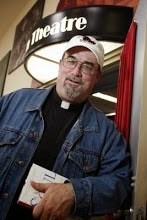
Rick Malloy's Articles on the Papal Election

An unnamed pilgrim prays in St. Peter's square as the Cardinals discern and vote.
These two articles, aimed at helping college students appreciate what is going on with the resignation of Pope Benedict and the subsequent conclave, appeared in the March editions of The Aquinas, the University of Scranton Student newspaper. - Fr. Rick
********************************************
Soon, “Habemus Papam”
Richard G. Malloy, S.J., Ph.D.
Vice President for University
Mission and Ministry, the University of Scranton
There’s another kind of March Madness in
the air. Some are calling it “The Sweet
Sistine.” Chris Chase at CNN analyzed the
outcome according to his reading of how the NCAA usually goes (e.g., favorites
don’t win; teams with saints’ names don’t cut down the net) and came up with
Cardinal Christoph Schoenborn as the next Pope (http://www.usatoday.com/story/gameon/2013/02/27/papal-brackets-ncaa-tournament-pope/1950543/). If the Austrian Schoenborn is elected, you
heard it here first!
The College of Cardinals of the Roman
Catholic Church is selecting a new Pope.
Prayerfully open to the influence of the Holy Spirit, they will elect a
new leader of the Church, the pilgrim people of God. The new Pope will be the Bishop of Rome and
the spiritual leader of 1.2 billion Catholics across the globe. That’s 17.5% of the 7 billion plus people who
populate the planet. The church grew by
29% from 1990 to 2010. There has been
explosive growth in the third world: a 109% increase in Africa and 50% growth
in Asia. There are some 65
million Catholics in the U.S.
115 Cardinals will select the new
Pope. The Pope appoints Cardinals and
they are usually Archbishops, that is, Bishops of large dioceses. The Cardinals can select any Catholic man to
be Pope. He would then need to be
ordained a priest and Bishop, if he were not so already. They could make Stephen Colbert Pope! But the probability of their selecting
someone other than one of the 115 in the conclave is virtually nil. It was not until the 11th century
that the Cardinals began selecting the Pope.
In the early years of the church, the Bishop of Rome, like many other
Bishops was elected by the people of the diocese.
There have been Jesuit Cardinals, most
notably Cardinal Carlo Maria Martini who was the Bishop of Milan from
1980-2002. He was considered “papabili”
but time did not favor the possibility of his being elected. Some Jesuits have been named Cardinals late
in their lives to honor their service to the church, e.g., Cardinal Avery
Dulles, S.J., the famous theologian. Such Jesuits are often named Cardinal after
they pass the age of 80. Only Cardinals
younger than 80 can participate in the conclave.
The Bishop of Rome is the first among
equals. The Catholic Church is actually
a communion of Churches, each organized under the leadership and authority of a
Bishop. “The Church subsists in the
Catholic Church, which is governed by the successor of Peter and by the Bishops
in communion with him” (Lumen Gentium
8; CCC# 816)). Priests are the
assistants of the Bishop and are authorized to function in a diocese by the
Bishop and in communion with him. The
Bishops of the Church are united in their loyalty to, and acceptance of, the
leadership and authority of The Bishop of Rome, who is the successor of St.
Peter, the first Bishop of Rome (who by the way was a married man. More on that in a minute).
The Bishop of Rome is the visible sign
of unity that exists in the Church. He
is also known as the Pontiff, the Holy Father, the Vicar of Christ and the
Pope. The word “Pope” from the Latin papa and the Greek “pappas” is a little child’s word for “Daddy.” In the early centuries of the Church, the
Pope was known as the Father of the Poor.
“The Church is the Reign of Christ
already present in mystery” (Lumen
Gentium 3) and is essentially both human and divine… present in the world,
but as a pilgrim (Catechism of the
Catholic Church #771). It’s been said the church is a hospital for
sinners, not a showcase for saints. The
news lately has evidenced that fact.
Scottish Cardinal Keith O’Brien had to recuse himself due to his sexual
misconduct. Many have questioned the
participation of Cardinal Law, formerly of Boston, and Cardinal Mahony of Los
Angeles due to their mishandling of the priests sex abuse scandals of the past
decades.
The new Pope will face many challenges.
In 1970 there were 419,728 priests and 1,004,304 religious sisters
worldwide. In 2012 there were 412,236
priests and 721,935 sisters. In 1965 in
the USA there were 58,632 priests and 179,954 sisters. In 2012 in our nation there were 38,964
priests and 54,018 sisters. The Catholic
population has grown tremendously, but vocations to priesthood and religious
life have not kept pace. Lay leadership
in the church will certainly increase in coming years.
The questions of married priests will be
one the new Pope will face immediately, especially since dozens of married
Episcopalian priests and protestant ministers have been ordained and are
serving as Catholic priests in parishes in the USA today. Women priests; the church’s teachings on moral
issues like contraception, homosexuality, and the use of drones in warfare; the
withering of church attendance and affiliation among the young of Europe and
the USA (in the USA, one in three raised Catholic in no longer practicing the
faith); and a host of other issues, most importantly the effects of the ongoing
sex abuse crises, will confront whoever is elected.
Given all that the new Pope will face,
let’s pray for the Cardinals as they deliberate and choose, and let’s pray for
our next Holy Father who will lead the church well into the 21st
century.
2025 2050
Africa 219 Million Catholics 342 Million Catholics
Asia 172 Million Catholics 207 Million Catholics
Europe 272 Million Catholics 256 Million Catholics
Latin
America 568 Million Catholics 646 Million Catholics
and
the Carribean
North
America 97 Million Catholics 113 Million Catholics
Oceania 11 Million Catholics 13 Million
Catholics
World
Wide 1.34 Billion Catholics 1.57 Billion Catholics
Saenz, Rogelio,
“The Changing Demographics of Roman Catholics” (2005) http://www.prb.org/Articles/2005/TheChangingDemographicsofRomanCatholics.aspx . Accessed Mar 1 2013
***************************************************************
Pope Benedict XVI Steps Down.
Richard G. Malloy, S.J., Ph.D.
Vice President for University
Mission and Ministry, the University of Scranton
This week we saw something that hasn’t
happened in 719 years. A Pope resigned. This is a wise and humble choice on the part of
Benedict XVI. He has led the church
since 2005, taking over from the charismatic and beloved John Paul II. Admittedly more shy and less media savvy and charismatic
than his predecessor, Benedict has charmed many he visited, e.g. his USA trip in
2008.
Celestine V in 1294 A.D. was the last
Pope to voluntarily resign as the leader of the Roman Catholic Church. (Gregory XII was forced to resign in 1415,
and so ended a painful schism, in the Western church where two Popes were
claiming the Papacy).
Benedict’s eight years as head of the
world’s more than one billion Catholics have not been easy. He had to deal with the never ending
revelations of priests’ sex scandals and Bishops mishandling of these
matters. Benedict XVI has been less the conservative
enforcer some predicted and has certainly not made the conservative –liberal logjam
any worse than it was when he took office.
Still, relations with religious women, and especially two well respected
female theologians, Margaret Farley and Elizabeth Johnson, did not please the
Catholic left. But the Catholic right
has not been pleased with what some see as his unwillingness to take a hard
line and “crack down” on dissenters.
This Pope is a brilliant theologian and
an astute reader of the signs of the times.
He realizes that women and men of faith gain more by the patient and
prayerful work of persuasion than the bludgeon of deafening dogma. In the long run, dictators never win true
allegiance of hearts and minds.
Especially in his writings (hundreds of
articles, multiple books, Encyclicals and three recent popular books on the
life of Jesus), Benedict has been a voice of faith grounded in solid biblical
scholarship. Jim Martin, S.J., notes,
“in [his] books, the pope brought to bear decades of scholarship and prayer to
the most important question that a Christian can ask: Who is Jesus? This is the pope’s primary job--to introduce
people to Jesus--and Pope Benedict did that exceedingly well.” http://americamagazine.org/content/all-things/popes-legacy
Benedict’s voice calls for faith in an
age where faith is fragile. The erosion
of faith in European and First world countries threatens the life of the church. Yet hope rises where the church is
blossoming, in places like Africa, Asia and Latin America. China has seen Christianity grow
exponentially in recent decades.
In his Introduction to Christianity, Benedict writes, “one could very well
describe Christianity as a philosophy of freedom” and “The Christian message is
basically nothing else than the transmission of the testimony that love has
managed to break through death here and thus has transformed fundamentally the
situation of us all.” (1968, p. 158; p. 307)
Jesuit Father Drew Christiansen argues
that Benedict’s “encyclical Caritas in Veritate, with its affirmation
of structural reform as ‘political charity’ and his call for a global authority
to regulate the financial sector, may be the most radical since John XXIII's Pacem
in terris 50 years ago.” http://americamagazine.org/content/all-things/benedicts-legacy
In Jesus
of Nazareth, Benedict movingly reveals his view of God who exists in loving
relationship. “We see that to be God’s
child is not a matter of dependency, but rather of standing in the relation of
love that sustains man’s existence and gives it meaning and grandeur. One last question: Is God also Mother? The Bible does compare God’s love with the
love of a mother. … The mystery of God’s maternal love is
expressed with particular power in the Hebrew word rahamim, … ‘womb,’ later used to mean divine compassion, … God’s
mercy. The womb is the most concrete
expression for the interrelatedness of two lives and of loving concern…” (2007,
p. 139).
Joseph Ratzinger was born in 1927 and
ordained a priest in 1951. He has been serving
the church in many capacities for over six decades. He merits some time to relax, read and
pray. Maybe he’ll even have some more
time to write.
College students know how to use
twitter. “Tweet” the Pope at his twitter
handle “@pontifex” and say, “Thanks.”
Labels: conclave, jesuit, jesuits, papal election, Pope Benedict, pope. catholic church, Vatican
posted by A Jesuit's Jottings at
Wednesday, March 13, 2013
|
1 Comments