A Jesuit's Jottings
Rick Malloy, S.J., is a Jesuit priest and cultural anthropologist. He is the author of _A Faith That Frees: Catholic Matters for the 21st Century (2007) and _Being on Fire: The Top Ten Essentials of Catholicism_ (2014), both published by ORBIS Books
Monday, July 07, 2014
Thursday, December 05, 2013
About Pope Francis, NYimes Charles Blow much smarter than Rush Limbaugh (but everyone is smarter than Rush...)
http://www.nytimes.com/2013/12/05/opinion/blow-the-president-the-pope-and-the-people.html?hp&rref=opinion&_r=0
The President, the Pope and the People
By CHARLES M. BLOW
On Wednesday, while delivering a speech largely about income inequality
and economic mobility, a populist president invoked a populist pope.
After rattling off a laundry list of dire statistics, President Obama
cited Pope Francis: Labels: catholic, catholic social teaching, Charles Blow, income inequality, justice, limbaugh, pope francis
Wednesday, September 11, 2013
Rich Get Richer. 2012 the Rich "R" Richer than ever....
The Rich Get Richer Through the Recovery
By ANNIE LOWREY http://economix.blogs.nytimes.com/2013/09/10/the-rich-get-richer-through-the-recovery/?src=me&ref=general
The top 1 percent took more than one-fifth of the income earned by Americans, one of the highest levels on record since 1913, when the government instituted an income tax.
The figures underscore that even after the recession the country remains in a new Gilded Age, with income as concentrated as it was in the years that preceded the Depression of the 1930s, if not more so.
High stock prices, rising home values and surging corporate profits have buoyed the recovery-era incomes of the most affluent Americans, with the incomes of the rest still weighed down by high unemployment and stagnant wages for many blue- and white-collar workers.
“These results suggest the Great Recession has only depressed top income shares temporarily and will not undo any of the dramatic increase in top income shares that has taken place since the 1970s,” Mr. Saez, an economist at the University of California, Berkeley, wrote in his analysis of the data.
The income share of the top 1 percent of earners in 2012 returned to the same level as before both the Great Recession and the Great Depression: just above 20 percent, jumping to about 22.5 percent in 2012 from 19.7 percent in 2011.
That increase is probably in part due to one-time factors. Congress made a last-minute deal to avoid the expiration of all of the Bush-era tax cuts in January. That deal included a number of tax increases on wealthy Americans, including bumping up levies on investment income. Seeing the tax changes coming, many companies gave large dividends and investors cashed out.
But the economists noted that the trends looked the same for income figures including and excluding realized capital gains — implying that the temporary tax moves were not the only reason the top 1 percent did so well relative to everyone else in 2012.
More generally, richer households have disproportionately benefited from the boom in the stock market during the recovery, with the Dow Jones industrial average more than doubling in value since it bottomed out early in 2009. About half of households hold stock, directly or through vehicles like pension accounts. But the richest 10 percent of households own about 90 percent of the stock, expanding both their net worth and their incomes when they cash out or receive dividends.
The economy remains depressed for most wage-earning families. With sustained, relatively high rates of unemployment, businesses are under no pressure to raise their employees’ incomes because both workers and employers know that many people without jobs would be willing to work for less. The share of Americans working or looking for work is at its lowest in 35 years.
There is a glimmer of good news for the 99 percent in the report, though. Mr. Piketty and Mr. Saez show that the incomes of that group stagnated between 2009 and 2011. In 2012, they started growing again — if only by about 1 percent. But the total income of the top 1 percent surged nearly 20 percent that year. The incomes of the very richest, the 0.01 percent, shot up more than 32 percent.
The new data shows that the top 1 percent of earners experienced a sharp drop in income during the recession, of about 36 percent, and a nearly equal rebound during the recovery of roughly 31 percent. The incomes of the other 99 percent plunged nearly 12 percent in the recession and have barely grown — a 0.4 percent uptick — since then. Thus, the 1 percent has captured about 95 percent of the income gains since the recession ended.
Mr. Saez and Mr. Piketty have argued that the concentration of income among top earners is unlikely to reverse without stark changes in the economy or in tax policy. Increases that Congress negotiated in January are not likely to have a major effect, Mr. Saez wrote, saying they “are not negligible, but they are modest.”
Mr. Saez and Mr. Piketty, of the Paris School of Economics, plan to update their data again in January, after more complete statistics become available.
Labels: income inequality, rich v. poor, top one percent
Saturday, February 04, 2012
How economic inequality harms societies: Richard Wilkinson on TED.com
Here's a great 15 mins. on income inequality. - Fr. Rick
Labels: income inequality, Richard Wilkinson, TED talks
Friday, February 03, 2012
Don't Believe Charles Murray on Inequality
******************
Inequality and the Charles Murray Dodge
http://nymag.com/daily/intel/2012/01/inequality-and-the-charles-murray-dodge.htmlThe appearance of income inequality on the political agenda has left conservatives casting about for a response, and after several months of floundering, it has increasingly narrowed down to two words: Charles Murray. Murray is the author of a new book, Coming Apart: The State of White America, which attributes the decline of the middle class to deteriorating social norms. Non-elite whites, he argues, are failing to sustain healthy marriages or strong child-rearing and work habits, leading to economic decline.
I haven’t read Murray’s book, so I can’t evaluate the argument. I have many reasons for skepticism that it actually explains what it purports to explain. There’s Murray’s non-confidence-inspiring history, the intuitive possibility that deteriorating social norms are at least partially the result and not the cause of economic stagnation (it’s no longer easy for a blue-collar earner to support a family), and the simple fact that, you know, many Americans are not white, which limits the value of a book about white people as a totalistic social explanation. But even if we grant, for the sake of argument, all the claims being made on Murray’s behalf, the basic point is that it is not a plausible response to the problem of income inequality. It’s an attempt to change the subject.
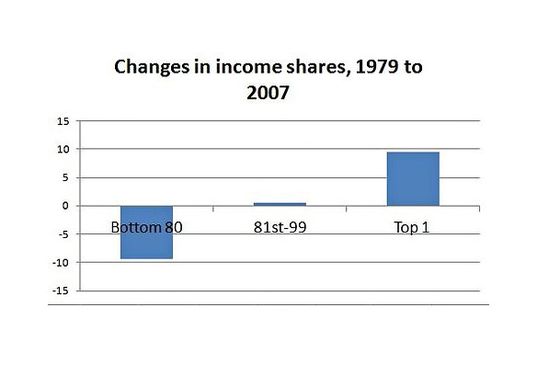
Rising income inequality is a phenomenon of the top one percent pulling away from everybody else. Conservatives want to redefine the question as concerning the top 20 percent against everybody else. If you redefine the question as being about the top quintile against the bottom four-fifths, then you can start talking about marriage and Charles Murray and safely steer the debate back onto comfortable conservative terrain. David Brooks tries that sleight of hand in his column today:
Democrats claim America is threatened by the financial elite, who hog society’s resources. But that’s a distraction. The real social gap is between the top 20 percent and the lower 30 percent. The liberal members of the upper tribe latch onto this top 1 percent narrative because it excuses them from the central role they themselves are playing in driving inequality and unfairness.
But these are two completely separate issues. Yes, the top 20 percent has done better than the bottom 80 percent, and it’s very worth exploring the role of social norms in this divergence. But income inequality has occurred between the top one percent and everybody else:
A more blunt version of this technique was previewed a couple months ago by the American Enterprise Institute’s James Pethokoukis, perhaps the right’s most enthusiastic inequality denier. Pethokoukis cited a chart, compiled by Political Calculations, purporting to show that the only change in inequality results from changed family status. Pethokoukis triumphantly presented this as the “The one chart that explodes the myth of U.S. income inequality,” and used it to segue, as Brooks does today, to Murray’s arguments about family values:
So what we have here, as always in America it seems, is culture trumping economics (though the data don’t take into account how different income groups have different inflation rates, another equalizer). AEI’s Charles Murray has a new book coming out that will expand on how values and culture influence inequality.
But the chart is completely wrong. Reader Jacques Distler pointed out to me that it relies on census data, which only asks households if they earn more than $100,000 a year. Since all the change in income inequality has come within households earning well over that mark, the census data is not going to capture the rise in income inequality. (Think of it this way. Imagine you want to show that basketball centers get taller as you move from high school to college to the NBA. If your tallest category is "six foot two and over,” you’re not going to show much of an effect.)
I e-mailed Lane Kenworthy, an inequality expert, who confirmed this for me. Inequality between the top one percent and everybody else has increased dramatically.
The growing gap between the top one percent and everybody else has a lot of important implications, the most immediate being a simple fight over resource allocation. Democrats insist that any fiscal adjustment require the richest one percent to make a meaningful contribution, while Republicans insist that it must not. That’s an important debate. The root causes of the gap between the top 20 percent and the bottom 80 percent is also interesting and important. But “hey, look – Charles Murray!” isn’t a very salient response to the problem of inequality.
Labels: catholic social teaching, charles murray, David Brooks, income inequality, top one percent
Friday, January 20, 2012
Newsweek lays out the case for class warfare. The rich are winning

Read it and weep. http://www.thedailybeast.com/newsweek/2012/01/15/niall-ferguson-a-conservative-take-on-america-s-economic-divide.html
Rich America, Poor America. Newsweek Jan 23, 2012.
"Adjusted for inflation, the income of the average American male has essentially flatlined since the 1970s, according to figures from the Census Bureau. The income of the bottom quarter of U.S. families has actually fallen. It’s been a different story for the rich."
Median compensation for CEOs of 500 largest corporation
1970 $1 million
2010 $13 million (1200% increase)
Median income in USA
1975 $12,000
2010 $49,000 (308% increase)
Percentage of income going to the top 1%
1933 24%
1973 09%
2007 24%


Labels: class warfare, income inequality, injustice, rich v. poor, social justice
Monday, January 16, 2012
King Had a Dream. Do we?
Freedom and Economic Justice: Rev. Martin Luther King's Unfinished Agenda
Richard G. Malloy, S.J., Ph.D.
In October of 1967, Rev. Martin Luther King spoke at St. Joe's in Philadelphia. In that speech, given just six months before he was assassinated, King stated, "Our goal is freedom. And I still have faith that we are going to get to that goal." The freedom King was speaking of that day was not simply racial equality. He was also speaking about economic justice. In his address, King spoke of the relative ease with which lunch counters had been desegregated, while he noted that it was proving much more difficult to eradicate the ghettos of the large Northern cities.
Earlier that year (August 1967) at Ebenezer Baptist Church in Atlanta, his home church, King delivered a sermon entitled "Where Do We Go from Here?," in which he directly articulates many of the themes of economic justice he would touch upon later in October in his talk. King argued:
"When the constitution was written, a strange formula … declared that the Negro was sixty percent of a person. Today another curious formula seems to declare that he is fifty percent of a person. Of the good things in life, the Negro has approximately one half those of whites. …half the income… twice as many unemployed. The rate of infant mortality among Negroes is double that of whites and there are twice as many Negroes dying in Vietnam as whites in proportion to their size in the population."
Note in the above quote, Rev. King putting to good use the methods of analyzing society he learned as an undergraduate Sociology major! What he was talking about near the end of his life was the simple truth that freedom and economic opportunity and equality were more than linked. You cannot have one without the other. Freedom and economic equality mutually condition one another.
Today, almost fifty years since the iconic "I Have a Dream Speech", some progress has been made, but there is still a long way to go. The median net worth of whites is ten times greater than that of African Americans.
Source: Prof. G. William Domhoff’s websitee. http://www2.ucsc.edu/whorulesamerica/power/wealth.html (accessed Jan 16, 2012)
The U.S. Census Bureau reports that median household income in the USA is $49,445. Median household income of whites ($54,620) is almost one third greater than that of Blacks ($32,068). And despite sincere efforts on so many levels, overt, vile racism is still evident in our society. Go to the Southern Poverty Law Center’s website ( http://www.splcenter.org/get-informed/hate-map) and see the virulent racism that still exists among us.
What would have happened if King's ideas were heeded? In his 1967 Atlanta speech, Rev. King called for the eradication of poverty in our midst. He proposed a Guaranteed National Income, an idea articulated at that time by John Kenneth Gailbraith and even championed by Richard Nixon a few years later. In 1967, it would have cost $20 billion for a Guaranteed National Income, about what we spent to put a man on the moon, and $15 billion less than the $35 billion we were wasting on the War in Vietnam. What would our country and the world look like today if poverty has been systematically eradicated thirty-five years ago?
In Martin Luther King, Jr., God sent us a prophet. The prophet spoke in our midst. And we have not yet heeded his message. The shortest verse in the Gospels is "Jesus wept" (John 11:35). There, Jesus is crying over the death of his friend Lazarus. I wonder what Jesus' reaction is to our society's inability/refusal to enflesh in law the principles of freedom and economic Justice, the principles for which Martin Luther King died at the young age of 39 years? Is Jesus weeping again? Maybe. Or maybe Jesus is calling us to Keep the Dream Alive, and bring to fruition the Dream of Rev. King. On that hot sweltering day in August 1963, King spoke of hope and healing, justice and joy.
“In a sense we have come to our nation's capital to cash a check. When the architects of our republic wrote the magnificent words of the Constitution and the Declaration of Independence, they were signing a promissory note to which every American was to fall heir. This note was a promise that all men, yes, black men as well as white men, would be guaranteed the unalienable rights of life, liberty, and the pursuit of happiness. It is obvious today that America has defaulted on this promissory note…. But we refuse to believe that the bank of justice is bankrupt. We refuse to believe that there are insufficient funds in the great vaults of opportunity of this nation. And so we have come to cash this check, a check that will give us upon demand the riches of freedom and the security of justice” (MLK, “I Have a Dream” Speech, 1963)
King had a dream. Do we?
Labels: catholic social teaching, income inequality, martin luther king, mlk
How much do the top 1% get?

Source: Congressional Budget Office, Average Federal Taxes by Income Group, “Average After-Tax Household Income,” June, 2010. (This graph found at http://inequality.org/income-inequality/)
Today's New York Times article on inequality has numbers much lower than Mother Jones or Inequality.org.
NY Times says family income of $338,001 puts a family in top 1%.
Mother Jones and Inequality.org put the top 1% at well over a $1,000,000 average annual family income. The CBO agrees with Mother Jones and Inequality.org.
Maybe the NYTimes only counts earned income? Many of the Superrich receive little income but live off inheritance and investment income.
***
Labels: catholic social teaching, income inequality, motherjones, New York Times
Thursday, January 05, 2012
NOT Movin' on Up. Social Mobility in the USA
“It’s becoming conventional wisdom that the U.S. does not have as much mobility as most other advanced countries,” said Isabel V. Sawhill, an economist at the Brookings Institution. “I don’t think you’ll find too many people who will argue with that.”
January 4, 2012 Harder for Americans to Rise From Lower Rungs
By JASON DePARLE
WASHINGTON — Benjamin Franklin did it. Henry Ford did it. And American life is built on the faith that others can do it, too: rise from humble origins to economic heights. “Movin’ on up,” George Jefferson-style, is not only a sitcom song but a civil religion.READ MORE http://www.nytimes.com/2012/01/05/us/harder-for-americans-to-rise-from-lower-rungs.html?_r=1&hp
"Meanwhile, just 8 percent of American men at the bottom rose to the top fifth. That compares with 12 percent of the British and 14 percent of the Danes."
" Now the evidence suggests that America is not only less equal, but also less mobile."
Labels: catholic social teaching, income inequality, injustice, social mobility
Wednesday, November 02, 2011
David Brooks on the Wrong Inequality

IMHO, Brooks makes too light of the connection between the 1% and their taking so much of the pie, and the deplorable conditions of those on the bottom end of the scale, but his point is worth pondering. Even if we get (or force) the top 1% and the other fat cats to share more of their unjust share of the wealth, how will those at the bottom benefit if we do not provide education and other opportunities? Have we fallen so far that, even if we reduce inequality, the bottom 20% or 50% will not know how to reap the benefits? - Rick
*********************
http://www.nytimes.com/2011/11/01/opinion/brooks-the-wrong-inequality.html?_r=1&ref=davidbrooks
We live in a polarizing society, so perhaps it’s inevitable that our experience of inequality should be polarized, too.
In the first place, there is what you might call Blue Inequality. This is the kind experienced in New York City, Los Angeles, Boston, San Francisco, Seattle, Dallas, Houston and the District of Columbia. In these places, you see the top 1 percent of earners zooming upward, amassing more income and wealth. The economists Jon Bakija, Adam Cole and Bradley Heim have done the most authoritative research on who these top 1 percenters are.
Roughly 31 percent started or manage nonfinancial businesses. About 16 percent are doctors, 14 percent are in finance, 8 percent are lawyers, 5 percent are engineers and about 2 percent are in sports, entertainment or the media.
If you live in or around these big cities, you see stores and entire neighborhoods catering to the top 1 percent. You see a shift in social norms. Up until 1970 or so, a chief executive would have been embarrassed to take home more than $20 million. But now there is no shame, and top compensation zooms upward.
You also see the superstar effect that economists have noticed in the income data. Within each profession, the top performers are now paid much better than the merely good or average performers.
If you live in these big cities, you see people similar to yourself, who may have gone to the same college, who are earning much more while benefiting from low tax rates, wielding disproportionate political power, gaining in prestige and contributing seemingly little to the social good. That is the experience of Blue Inequality.
Then there is what you might call Red Inequality. This is the kind experienced in Scranton, Des Moines, Naperville, Macon, Fresno, and almost everywhere else. In these places, the crucial inequality is not between the top 1 percent and the bottom 99 percent. It’s between those with a college degree and those without. Over the past several decades, the economic benefits of education have steadily risen. In 1979, the average college graduate made 38 percent more than the average high school graduate, according to the Fed chairman, Ben Bernanke. Now the average college graduate makes more than 75 percent more.
Moreover, college graduates have become good at passing down advantages to their children. If you are born with parents who are college graduates, your odds of getting through college are excellent. If you are born to high school grads, your odds are terrible.
In fact, the income differentials understate the chasm between college and high school grads. In the 1970s, high school and college grads had very similar family structures. Today, college grads are much more likely to get married, they are much less likely to get divorced and they are much, much less likely to have a child out of wedlock.
Today, college grads are much less likely to smoke than high school grads, they are less likely to be obese, they are more likely to be active in their communities, they have much more social trust, they speak many more words to their children at home.
Some research suggests that college grads have much bigger friendship networks than high school grads. The social divide is even starker than the income divide.
These two forms of inequality exist in modern America. They are related but different. Over the past few months, attention has shifted almost exclusively to Blue Inequality.
That’s because the protesters and media people who cover them tend to live in or near the big cities, where the top 1 percent is so evident. That’s because the liberal arts majors like to express their disdain for the shallow business and finance majors who make all the money. That’s because it is easier to talk about the inequality of stock options than it is to talk about inequalities of family structure, child rearing patterns and educational attainment. That’s because many people are wedded to the notion that our problems are caused by an oppressive privileged class that perpetually keeps its boot stomped on the neck of the common man.
But the fact is that Red Inequality is much more important. The zooming wealth of the top 1 percent is a problem, but it’s not nearly as big a problem as the tens of millions of Americans who have dropped out of high school or college. It’s not nearly as big a problem as the 40 percent of children who are born out of wedlock. It’s not nearly as big a problem as the nation’s stagnant human capital, its stagnant social mobility and the disorganized social fabric for the bottom 50 percent.
If your ultimate goal is to reduce inequality, then you should be furious at the doctors, bankers and C.E.O.’s. If your goal is to expand opportunity, then you have a much bigger and different agenda.
Labels: catholic social teaching, David Brooks, income inequality, New York Times, occupy wall street, social justice
Friday, October 21, 2011
Occupy Wall Street: More on Income Inequality in USA


Here are some good links to info on inequality in the USA.
Income Inequality
http://inequality.org/income-inequality/
Mother Jones tells it like is is.
http://motherjones.com/politics/2011/02/income-inequality-in-america-chart-graph
Huffington Post provides charts
http://www.huffingtonpost.com/2011/04/05/us-inequality-infographic_n_845042.html#s261411&title=Wage_Inequality
Labels: catholic social teaching, income inequality, occupy wall street